
EASE OUT of Chronic Tension, Pain, Fatigue & Overwhelm

Week 5: Trust
"Collecting Evidence You Can Trust Your Body"
False Belief: "My body is weak and fragile."
Sometimes we become so focused on what feels wrong that we stop noticing everything our body is already doing right.
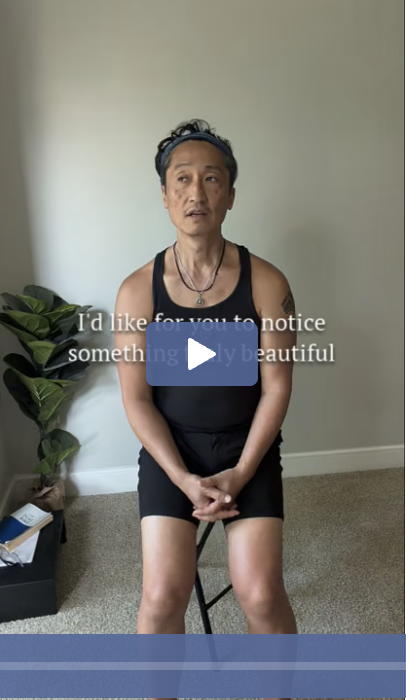
Click to play
What you experience today:
What it feels like to notice the supports and all that's already going right.
In today’s session, you’ll explore:
✓ How quickly your body responds to support
✓ Why attention can become overly focused on what feels wrong
✓ How vigilance can affect the way we relate to our body and even other people
✓ Why trust doesn't require ignoring potential problems
✓ How to begin collecting evidence that your body is already supporting you
The goal today is simple.
See more of what is already working.
Today’s Practice
Once or twice today, pause.
Notice your body.
But this time, don't begin by looking for tension.
Instead, ask:
What is supporting me right now?
Maybe it's the chair beneath you.
The floor beneath your feet.
The bed holding your body.
The structure of your joints.
Your breath moving without you managing it.
Your heart continuing to beat.
Your body adjusting to the position you're in.
Notice something that is already happening without you forcing it.
Then ask:
"What evidence is my body giving me that I can trust it?"
Maybe you notice how quickly your jaw responds when you become aware of it.
Maybe your breath changes when you stop managing it.
Maybe your shoulders ease one percent.
Maybe your body tells you when it needs rest.
Maybe it tells you when you've done enough.
Maybe it has carried you through some of the hardest moments of your life.
Don't try to convince yourself that your body is trustworthy.
Collect evidence.
Let your body show you.
An 80/20 Experiment
Today, experiment with where your attention goes.
You don't need to ignore symptoms.
You don't need to stop being aware of concerns.
But notice whether the thing that feels wrong is receiving 80 or 90 percent of your attention.
Then experiment.
Could you give a little more attention to:
• what is supporting you
• what is responding
• what is adapting
• what is working
• what feels stable
• what your body is already doing for you
Not as positive thinking.
Not as denial.
As observation.
See if you can begin noticing more of the whole picture.
Check In With Me
To get the most out of this program, reply by TEXT at
(469) 290-2531
-or- Email
And tell me:
"What was your biggest takeaway from today's session?"
And answer this question:
"What evidence did you notice today that your body may be more trustworthy than you've been giving it credit for?"
Maybe:
• My body responded when I stopped trying so hard
• I noticed how supported I felt sitting
• My breath was already happening without me managing it
• My body told me I needed a break
• I realized my body has carried me through a lot
• I noticed I focus much more on what feels wrong
• I'm not sure yet, but I'm starting to look
There are no wrong answers.
We're not trying to manufacture trust.
We're learning to notice the evidence that may have been there all along.
Attention is limited.
When something feels threatening, uncertain, or important, the brain naturally gives it greater priority.
This can be useful.
It helps us identify potential problems and respond when necessary.
But when attention repeatedly returns to symptoms, discomfort, or signs that something may be wrong, those signals can begin dominating our experience.
We may become highly skilled at detecting what feels off while becoming less aware of stability, support, and successful adaptation.
Today's practice is not about suppressing symptoms or replacing negative thoughts with positive ones.
It is about widening attention.
Instead of only asking:
What's wrong?
We also begin noticing:
What's supporting me?
What's responding?
What's working?
What evidence do I have?
Over time, these experiences may help create a more complete and accurate perception of the body.
Not a perfect body.
Not a symptom-free body.
A body that is continually responding, adapting, communicating, and supporting you.
Selected References
Van Damme, S., Legrain, V., Vogt, J., & Crombez, G. (2010). Keeping pain in mind: A motivational account of attention to pain. Neuroscience & Biobehavioral Reviews, 34(2), 204–213.
Crombez, G., Eccleston, C., Van Damme, S., Vlaeyen, J. W. S., & Karoly, P. (2012). Fear-avoidance model of chronic pain: The next generation. Clinical Journal of Pain, 28(6), 475–483.
Wiech, K., Ploner, M., & Tracey, I. (2008). Neurocognitive aspects of pain perception. Trends in Cognitive Sciences, 12(8), 306–313.
Stay With The Process
This session will remain available for the next 7 days.
The timer isn't here to create pressure.
It's simply here to help you stay connected to the practice while it's fresh.
If you ever need access again, just text or email me.
For today:
Don't force yourself to trust your body.
Look for the evidence.
Notice the support.
See the beauty.
Let your body show you.
That's enough.