
EASE OUT of Chronic Tension, Pain, Fatigue & Overwhelm

Week 2: Efficiency In Body
Finding "Just Enough" Effort
False Belief: "How I do ordinary everyday activities don't matter that much."
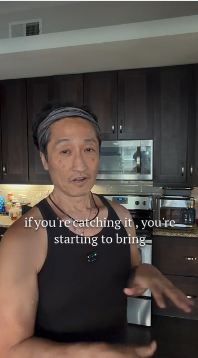
Click to play
What you experience today:
Feel what's it like to lower effort in everyday activities to "just enough."
You also learn:
✓ Why noticing extra effort is good but excessive monitoring isn't
✓ Why your body might be in a rush even when you are not
✓ Why it might feel strange to go slower
✓ Why choosing to go faster is different than your body running the old pattern
✓ How to choose an activity and use it to practice this work and why practice is important
✓ How the meaning you place onto a task can turn it into a trigger
The goal today is not to fix your body.
It’s not to relax everything.
It’s to begin helping your system discover that some tasks can be done with less protective effort than it has been using.
TODAY'S INSTRUCTION:
Today, choose one small task that you do every day.
Pick something simple and repeatable, like:
• brushing your teeth
• washing your hands
• washing one dish
• walking from one room to another
• sitting down at your computer
• getting up from a chair
• making coffee or tea
• opening the fridge
• putting on your shoes
Step 1: Do it once the way you normally would.
Don’t change anything yet.
Just notice.
- Is your jaw working?
- Are your shoulders lifted?
- Is your stomach gripping?
- Is your breath paused?
- Are your hands working harder than they need to?
- Is there urgency in the task, even though the task itself isn’t urgent?
Step 2: Do it again, but with a little less effort.
Not dramatically less.
Not limp.
Not slow for the sake of slow.
Just a little less bracing.
A little less pushing.
A little less “trying.”
Let the task be supported.
Let your jaw soften a little.
Let your shoulders drop a little.
Let your breath move.
Let the task happen with just enough effort.
Step 3: Notice what changes.
Does anything soften?
Does the task feel different?
Does your breathing change?
Do you feel less pressure?
Do you notice how much effort you were adding before?
You do not need a dramatic shift.
Even noticing the difference is enough.
That’s the practice.
Use that same task once or twice a day as your practice lab until the next lesson.
Check In With Me
To get the most out of this program, reply by TEXT at
(469) 290-2531
-or- Email
And tell me:
"What was your biggest takeaway from today's session?"
And answer these two questions:
1) Which task did you choose as your practice lab?
2) What did you notice when you tried doing it with “just enough” effort instead of your usual effort?
Examples:
• “I noticed I was holding my breath while brushing my teeth.”
• “I realized I rush through washing dishes like I’m late for something.”
• “My shoulders softened when I walked to the kitchen.”
• “I didn’t notice a change yet, but I could tell I was trying hard.”
• “I kept wanting to do it ‘right’ instead of just noticing.”
There are no wrong answers.
The point is not to perform the task correctly.
The point is to notice how your system usually approaches it — and to begin experimenting with another option.
The body doesn’t only respond to what you do.
It also responds to how you do it.
Two people can do the exact same task and have very different experiences depending on how much protective effort their system is adding.
And you can do the exact same task on two different days and feel very different depending on how loaded or protected your system already is.
When the system is in a more protective state, ordinary tasks often come with extra effort:
• jaw tension• shoulder lifting• stomach gripping• breath holding• rushing• gripping with the hands• over-focusing• trying to “get through it”• doing more than the task actually requires
These are not flaws.
They’re often signs that the body is trying to support, stabilize, protect, or prepare.
But over time, that extra effort can quietly add more load to the system than the task itself requires.
This is why ordinary tasks are such a powerful place to practice.
They happen every day.
They’re low stakes.
And they give your system repeated opportunities to discover:
“I may not need this much effort here.”
That’s not just a mental shift.
It’s a physical one.
Selected References
Brosschot, J. F., Gerin, W., & Thayer, J. F. (2006). The perseverative cognition hypothesis: A review of worry, prolonged stress-related physiological activation, and health. Journal of Psychosomatic Research, 60(2), 113–124.
McEwen, B. S. (1998). Protective and damaging effects of stress mediators. The New England Journal of Medicine, 338(3), 171–179.
Sterling, P. (2012). Allostasis: A model of predictive regulation. Physiology & Behavior, 106(1), 5–15.
Moseley, G. L., & Butler, D. S. (2017). Explain Pain Supercharged. NOI Group Publications.
Stay With The Process
This session will be available for the next 3 days.
Not because you're behind.
Not because you need to rush.
But because small, consistent moments of awareness tend to create more change than occasional big efforts.
If you need access again after the timer expires, just text or email me and I'll make sure you have what you need.
For now, keep it simple:
Pick one task.
Notice your usual effort.
Then see what happens when you let your body do it with just enough.