
EASE OUT of Chronic Tension, Pain, Fatigue & Overwhelm

Week 6: Returning
"The deeper skill"
False Belief: "I must keep perfect awareness."
This work was never about that...
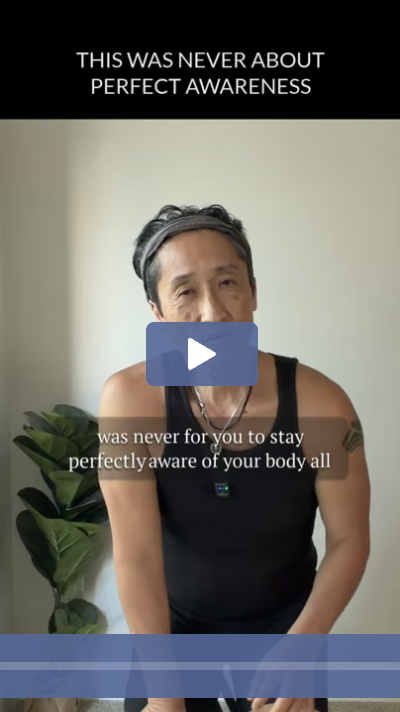
Click to play
Today is not about adding another practice.
It is about recognizing one of the most important abilities you have been developing:
the ability to return.
You do not need to remain aware of your body all day.
You do not need to prevent every moment of rushing, gripping, bracing, or breath holding.
You only need to begin recognizing that when you notice you have moved away from yourself, you can come back.
..........
As these six weeks come to an end, you may wonder whether you will be able to maintain what you have learned.
You may be concerned that you will:
- Become busy again
- Forget to notice
- Return to old patterns
- Experience another flare
- Override your signals
- Lose the progress you have made
But the goal was never to stay perfectly connected at all times.
Trying to maintain constant awareness can become another form of pressure.
It can cause you to monitor yourself, judge every reaction, and worry that you are doing the work incorrectly.
The more sustainable skill is simpler:
Notice when you have moved away—and return without criticism.
You may notice after a few moments.
You may notice at the end of the day.
You may notice after several difficult days.
The timing does not determine whether you have failed.
The moment you notice is the moment the return becomes possible.
Returning does not mean forcing your body to relax.
It may mean:
- Feeling the chair beneath you
- Noticing that you are rushing
- Recognizing a held breath
- Allowing your jaw to be less involved
- Using five percent less effort
- Letting the tension be present without fighting it
- Continuing more gently
- Pausing before pushing farther
Sometimes your body will soften.
Sometimes it will not.
The return still matters.
When your body does not change immediately, returning may simply mean becoming less frightened by what you feel and less urgent about making it go away.
That is not giving up.
It is removing the additional pressure that often keeps the protective pattern going.
Today’s Practice
Choose one ordinary activity today.
It could be:
- Standing up
- Opening your computer
- Walking into another room
- Preparing food
- Washing your hands
- Beginning an exercise
- Answering a message
As you begin, notice:
- Where is your attention?
- What is your body doing?
- Are you rushing, gripping, pressing, bracing, or holding your breath?
- Can you feel one place where you are supported?
- Is all of the effort you are using necessary right now?
Do not search for a dramatic release.
Allow a small change only if it is naturally available.
Then return to the activity.
The practice is not staying perfectly connected.
The practice is discovering that you can come back.
...........
Today, practice one intentional return.
That is all.
You do not need to repeat it throughout the day unless another moment naturally catches your attention.
When you notice that you have moved away from yourself, try saying:
“I noticed. I can begin from here.”
Then feel one point of support, allow a little less unnecessary effort if possible, and continue.
Check In With Me
To get the most out of this program, reply by TEXT at
(469) 290-2531
-or- Email
And tell me:
"What was your biggest takeaway from today's session?"
Take a moment to reflect:
- What helped you realize you had moved away?
- Did you immediately try to fix what you noticed?
- Could you return without criticizing yourself?
- Did anything shift when you stopped demanding a result?
- What would make returning feel simpler in everyday life?
There is no correct experience.
Even recognizing how difficult it is to return without trying to fix yourself is useful information.
Consider this question:
What if progress is not measured by how rarely I lose connection, but by how safely I know how to return?
You may not always notice early.
You may not always feel a release.
You may not always know what your body needs.
But you can become more familiar with beginning again.
That familiarity becomes trust.
Stay With The Process
This session will remain available for the next 5 days.
You do not have to hold tightly to what you have learned.
You do not have to protect your progress by doing everything correctly.
This work can become something much quieter.
You notice.
You return.
You continue.
Sometimes the return will happen quickly.
Sometimes it will take longer.
But the path remains available.
You are not starting over each time you return.
Returning is the practice.