
EASE OUT of Chronic Tension, Pain, Fatigue & Overwhelm

Week 6: Becoming
"This Is Already Becoming Part of You"
False Belief: "Change happens all at once in a big dramatic moment."
Sometimes the biggest changes are the ones easiest to overlook.
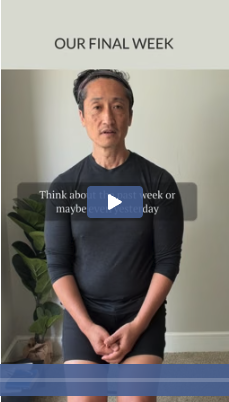
Click to play
Welcome to the Final Week
Over the past five weeks, we've explored many different ideas and practices.
We've noticed tension sooner.
We've experimented with using less effort.
We've learned to pause before reacting.
We've explored trusting our bodies instead of constantly testing them.
Today I'd like to step back and ask a different question.
Not...
"What have you learned?"
But...
"Who are you becoming?"
Because there comes a point where this work stops being another practice.
It quietly becomes the way you move through your day.
Something Begins to Change
When people first begin this work...
they often have to remember.
"I should notice."
"I should pause."
"I should soften."
Everything feels intentional.
Sometimes even awkward.
But something interesting begins happening with repetition.
You catch yourself sooner.
You notice your breath without trying.
You realize halfway through a task that you're using more effort than you need.
You don't always remember.
But you remember more often.
That's how new patterns begin.
Not because you're forcing them.
Because they're becoming familiar.
The Goal Was Never Perfect Awareness
If you've had days where you forgot...
days where symptoms came back...
days where you caught yourself only after the moment had already passed...
that's okay.
The goal was never to notice everything.
The goal was simply to notice sooner than you used to.
That's progress.
Today’s Practice
Today I'd like you to choose one ordinary activity.
Not because we're practicing that activity.
Because we're practicing being you.
It might be:
- brushing your teeth
- making coffee
- walking to your car
- washing dishes
- opening a door
- climbing stairs
Before you begin...
Pause.
Notice your body.
Then simply live the activity.
No trying to do it perfectly.
No searching for problems.
Just stay available.
If you notice yourself rushing...
Notice.
If you notice yourself holding your breath...
Notice.
If you notice yourself pushing...
Notice.
Then let your body decide whether anything wants to soften.
Continue.
What You're Really Practicing
You're not practicing...
breathing.
Or posture.
Or movement.
You're practicing something much deeper.
Returning.
Returning to yourself.
Again.
And again.
And again.
Eventually...
it stops feeling like something you remember to do.
It simply becomes how you meet life.
Check In With Me
To get the most out of this program, reply by TEXT at
(469) 290-2531
-or- Email
And tell me:
"What was your biggest takeaway from today's session?"
And after today's practice, ask yourself:
"Did I spend more of today inside my body...
or inside my thoughts?"
Not to judge.
Just to notice.
That question may become one of the most valuable practices you ever have.
One of the strongest predictors of lasting behavior change isn't motivation.
It's repetition in meaningful everyday contexts.
Researchers studying habit formation have found that behaviors gradually require less conscious effort when they're consistently repeated in familiar situations.
This process is sometimes called automaticity.
Rather than constantly remembering what to do, the brain begins recognizing familiar situations and responding with less conscious effort.
That's why everyday moments matter so much.
The more often awareness is practiced during ordinary life...
standing...
walking...
working...
talking...
the more naturally it begins appearing when you need it most.
You're not simply practicing exercises.
You're teaching your nervous system a new way of responding to everyday life.
Selected References
Lally, P., van Jaarsveld, C. H. M., Potts, H. W. W., & Wardle, J. (2010). How are habits formed? Modelling habit formation in the real world. European Journal of Social Psychology, 40(6), 998–1009.
Wood, W., & Rünger, D. (2016). Psychology of Habit. Annual Review of Psychology, 67, 289–314.
Graybiel, A. M. (2008). Habits, rituals, and the evaluative brain. Annual Review of Neuroscience, 31, 359–387.
Stay With The Process
This session will remain available for the next seven days.
The timer isn't here to create pressure.
It's simply a reminder to stay connected while these experiences are still fresh.
If you need access again after it expires, just text or email me.
For today, remember:
You don't become someone different in one extraordinary moment.
You become someone different...
through hundreds of ordinary moments...
where you remember to come back to yourself.
And over time...
that return becomes part of who you are.